The challenge
Restaurant Brands International's on-premises VDI had stopped keeping up with a geographically dispersed workforce. Users far from the datacentre absorbed the performance cost of every session, capacity could not flex with demand, and profile management had drifted into a decentralized arrangement that added administrative overhead.
Moving to Azure Virtual Desktop meant sizing a platform for concurrent use across very different roles and workloads, and standing it on a governed Azure Landing Zone rather than an ad hoc subscription. Two decisions had to be settled before any build: E1 plus VDA or E3 for licensing, and Nerdio Manager or Azure-native tooling for lifecycle automation.
Our approach
BITSUMMIT delivered the engagement in five phases, sequenced so each decision was closed and each layer confirmed before the next began.
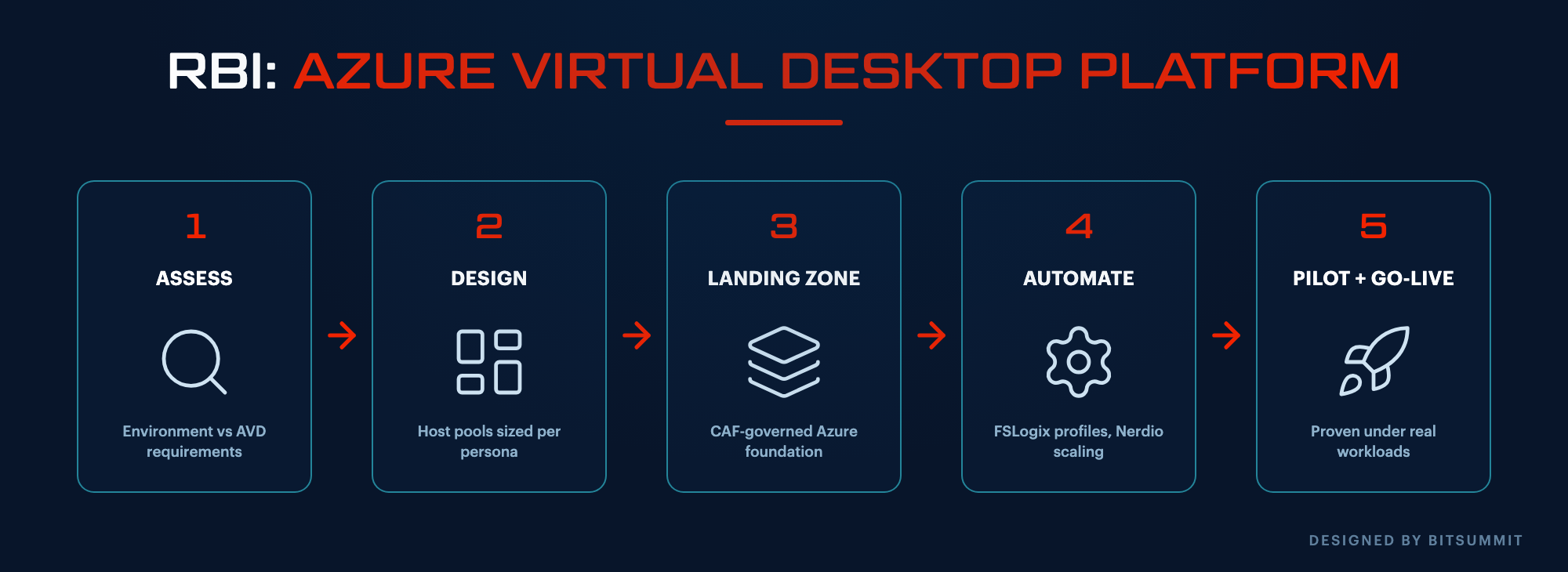
Assess the environment against what AVD requires
BITSUMMIT inventoried the existing Azure subscription, identity configuration and network path, verifying peering, routing, firewall rules and Conditional Access against AVD traffic requirements. The phase closed with a licensing cost comparison and a Nerdio Manager for Enterprise decision matrix. RBI selected Nerdio.
Design the platform in full
Session host density was calculated against concurrency targets, CPU and RAM sizing and application workload, with production separated from pilot and DevTest host pools. FSLogix container strategy was mapped per persona on Azure Files Premium, sized to measured IOPS and throughput.
Build on a governed landing zone
The Azure Landing Zone was established to Cloud Adoption Framework standards. Windows 11 multi-session images were published to a Shared Image Gallery for versioned updates, FSLogix was configured for profile containerization, and Nerdio Manager took over image management, auto-scaling and session host provisioning.
Integrate and validate Intune
Enrolment settings, compliance rules and device security profiles were validated against the existing Intune tenant, with Entra ID groups established for pilot and production assignment and policy application confirmed on enrolled session hosts.
Prove it under real workloads
A controlled pilot took the environment into daily work. UAT covered login, session establishment and multi-session concurrency, with launch times, latency and FSLogix performance measured in Azure Monitor. Defects were remediated and retested before stakeholder sign-off on the go-live checklist.
The outcome
RBI's on-premises VDI is retired. A pooled Azure Virtual Desktop platform now serves staff across purpose-built host pools, with profiles centralized in FSLogix on Azure Files Premium and Nerdio Manager handling image lifecycle and policy-based scaling. Off-peak and weekend scaling ties infrastructure cost to actual demand.
Nothing reached production unproven. The pilot cleared functional and performance issues that would otherwise have arrived as post-deployment rework, and both the licensing and automation decisions were made against documented comparisons. RBI owns the platform documentation, the operating runbooks and a repeatable image pipeline.